
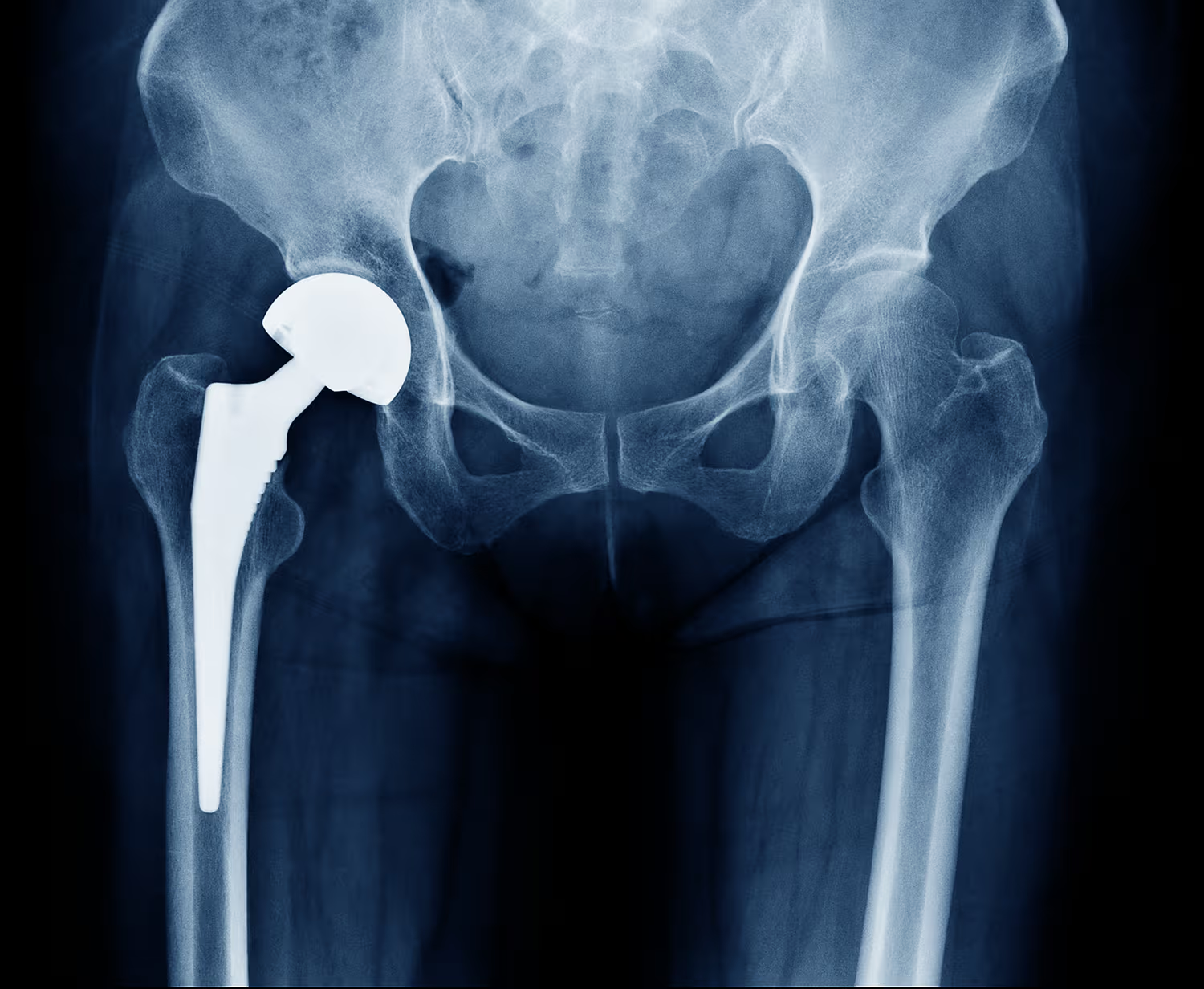
If your doctor has recommended a total hip replacement, you may have heard about different ways to perform the surgery. Two of the most common are the anterior approach and the posterior approach. Both replace the damaged hip joint. But they get there in very different ways — and that matters for your recovery.
This post breaks down what each approach involves, what it means for your body, and what to expect afterward.
To replace the hip, a surgeon needs to move through different layers of tissue to reach the actual joint. The path through the tissue that is taken — front, side, or back — determines which muscles get moved or cut, how quickly you recover, and what precautions you'll need to follow after surgery.
Think of it like taking a trip. There is more than one path to get to the destination, but all paths lead to the same place. The journey of each path has its own unique obstacles and scenery.
With this method, the surgeon makes an incision on the front side of the hip close to where the pocket of your pants sits. They work through a natural gap between muscles — typically without cutting any of them.
BENEFITS: Because no muscles are cut, many patients can experience less pain in the early days after surgery and move with greater ease. Hip precautions (restrictions on movement) are often minimal or not needed at all. XR imaging in the OR is more easily used to place the implants in the correct position. For some patients with medical issues, it is safer to lie on your back during surgery than on your side.
RISKS: This approach requires specialized training and equipment (like a special operating table). It has a learning curve — outcomes can depend heavily on how experienced your surgeon is with this technique. There is also a small risk of numbness on the outer thigh due to a nerve that runs near the incision.
With this method, the surgeon makes an incision just behind the femur bone on the hip. A small group of muscles at the back of the joint — called the short external rotators — are cut, and later reattached, to reach the hip socket.
BENEFITS: This is the most widely used approach worldwide. Surgeons have decades of experience with it, and it works well for a wide range of patients — including those who are larger or need a revision surgery. It also gives excellent access to the hip socket, which helps with implant placement.
RISKS: Because some muscles are cut, recovery can be slightly slower in the first few weeks. Patients typically follow hip precautions for 6–12 weeks to protect the repaired muscles. During that time, most surgeons will have you avoid bending the hip past 90 degrees, crossing your legs, or rotating the foot inward. The risk of hip dislocation is slightly higher if precautions are not followed.
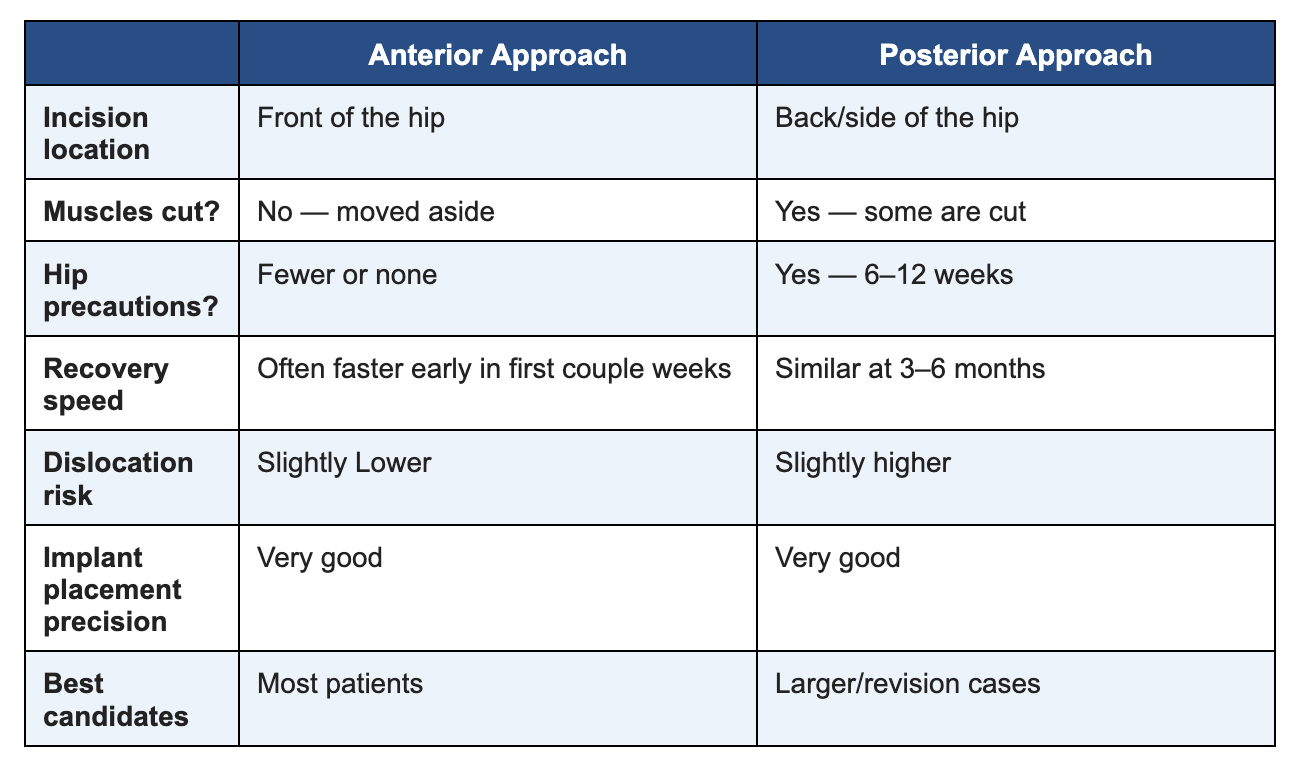
Here's an important truth: both approaches have strong track records. Patients who do well with one often would have done equally well with the other. The best choice depends on several things:
The most important step is to have an open conversation with your surgeon. Ask them which approach they recommend for you specifically — and why. A well-trained, experienced surgeon is the biggest factor in your outcome, regardless of which path they take to your hip.
Both the anterior and posterior approaches to hip replacement are safe and effective. The differences show up most in the first weeks of recovery — not in long-term results. Talk to your surgeon about what makes the most sense for your situation.
Successful recovery doesn't end in the operating room. Physical therapy can play a vital role in restoring strength, movement, balance, and confidence after hip replacement surgery.
The rehabilitation team at Bridger Orthopedic works closely with patients throughout the recovery process, helping them safely progress toward their goals and return to the activities they enjoy.
At Bridger Orthopedic, our fellowship-trained joint replacement specialists work with each patient to determine the most appropriate treatment plan based on their individual needs. Whether an anterior or posterior approach is recommended, the goal remains the same: reducing pain, restoring function, and helping patients get back to living life with less limitation.
If hip pain is affecting your daily activities, schedule an evaluation with Bridger Orthopedic to learn more about your treatment options and whether hip replacement may be right for you.