
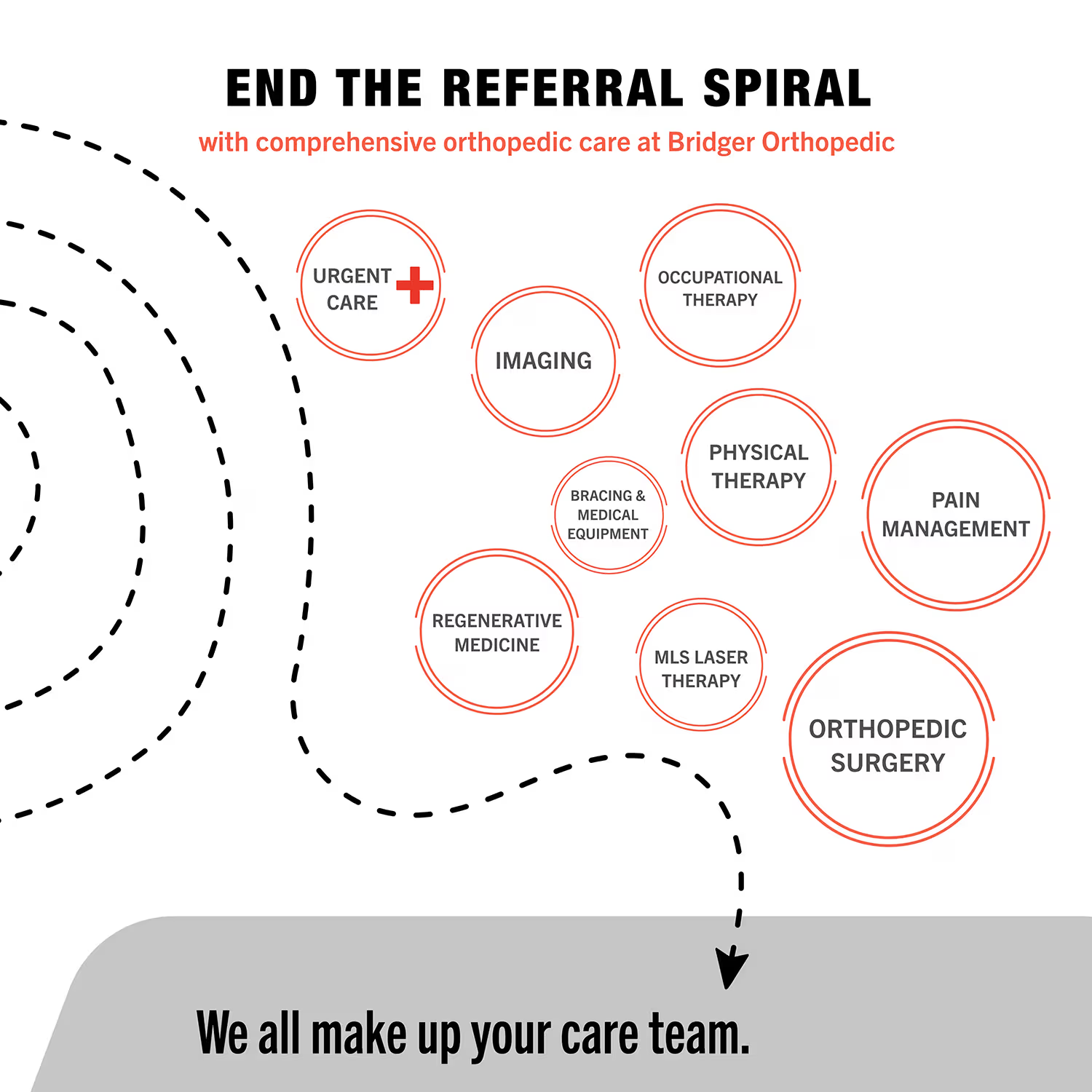
Recovering from an orthopedic injury can involve several types of care. Patients may need imaging, an orthopedic evaluation, pain management, and physical or occupational therapy. When those services operate separately, coordinating appointments, sharing medical information, and understanding the next steps can become challenging.
At Bridger Orthopedic, providers work together to make that process more connected. With walk-in orthopedic urgent care, on-site imaging, orthopedic surgeons, pain management, physical therapy, and occupational therapy, patients have access to multiple parts of the orthopedic care process within one practice.
Integrated orthopedic care brings different specialties and services together to support a patient's evaluation, treatment, and recovery.
Rather than relying on separate providers and facilities to coordinate every step, an integrated team communicates directly and shares relevant patient information. This helps providers understand the patient's history, current condition, and treatment progress.
Orthopedic injuries often require more than one type of treatment. A patient may begin with an urgent care evaluation, receive imaging to better understand the injury, and then work with an orthopedic specialist to determine the next steps. Depending on the condition, treatment may also include pain management, physical therapy, or occupational therapy.
When these services work together, patients have a more connected experience throughout their care.
At Bridger Orthopedic, multiple providers contribute to the patient's care plan. Each plays a different role, but communication between the team helps keep treatment moving in the same direction.
An injury can happen during sports, exercise, work, or everyday activities. When symptoms need attention, Bridger Orthopedics walk-in orthopedic urgent care provides an option for evaluation without needing to schedule a traditional appointment.
The care team assesses the injury, reviews symptoms, and determines what additional evaluation may be appropriate.
Imaging can help providers better understand the nature and extent of an orthopedic injury. Bridger Orthopedic offers on-site imaging, which can help connect the initial evaluation with the next steps in care.
Having imaging available within the practice also helps reduce the need to coordinate with a separate facility for certain diagnostic services.
When an injury requires specialized attention, our orthopedic team, including experienced physician assistants (PAs) and orthopedic surgeons, evaluates the condition, discusses appropriate treatment options, and develops a personalized care plan.
Depending on the diagnosis, treatment may involve conservative care, medication, injections, physical therapy, or surgery. For patients who need procedures such as ACL reconstruction, rotator cuff repair, or total knee replacement, the orthopedic team can help guide the surgical pathway.
Not every injury requires surgery. The goal is to identify an appropriate treatment approach based on the patient's condition, activity level, and individual needs.
Pain management, physical therapy, and occupational therapy can all play important roles in orthopedic recovery.
Pain management providers help address symptoms that may interfere with daily activities or rehabilitation. Physical therapists work with patients to improve strength, mobility, balance, and function. Occupational therapists help patients build the skills needed to return to everyday tasks and activities.
These services can support recovery after surgery or help patients manage certain conditions without surgery.
When providers communicate about a patient's progress, they can better coordinate treatment recommendations and adjust the care plan as needed.
A connected care team helps reduce some of the challenges that can come with navigating multiple specialties.
When providers share the patient's chart and communicate directly, they have better access to relevant information about previous evaluations, imaging, treatment recommendations, and rehabilitation progress.
This approach can help create:
Every injury and recovery timeline is different. A coordinated approach helps the care team respond to those individual needs while keeping treatment connected.
Orthopedic treatment looks different for every patient. Some conditions respond well to conservative treatment, while others may require surgery.
Bridger Orthopedic offers both surgical and non-surgical treatment options. This allows the team to consider different approaches based on the patient's diagnosis, goals, and overall health.
For example, a patient with knee pain may begin with an evaluation, imaging, and conservative treatment. If symptoms continue to affect mobility and daily activities, an orthopedic surgeon may discuss additional options, including total knee replacement when appropriate.
Having access to multiple specialties within one practice helps patients move between different stages of care with a team that understands their treatment history.
For active individuals and families throughout the Gallatin Valley, access to coordinated orthopedic services can make a difference in navigating an injury.
Bridger Orthopedic serves patients in Bozeman and Belgrade, Montana, with walk-in orthopedic urgent care, on-site imaging, orthopedic surgery, pain management, physical therapy, and occupational therapy.
Whether an injury needs an initial evaluation, ongoing treatment, or rehabilitation, the team works together to help patients understand their options and move forward with an appropriate care plan.
That is the foundation of integrated orthopedic care at Bridger Orthopedic.
If you need orthopedic care in Southwest Montana, visit bridgerorthopedic.com to learn more about available services and treatment options.